
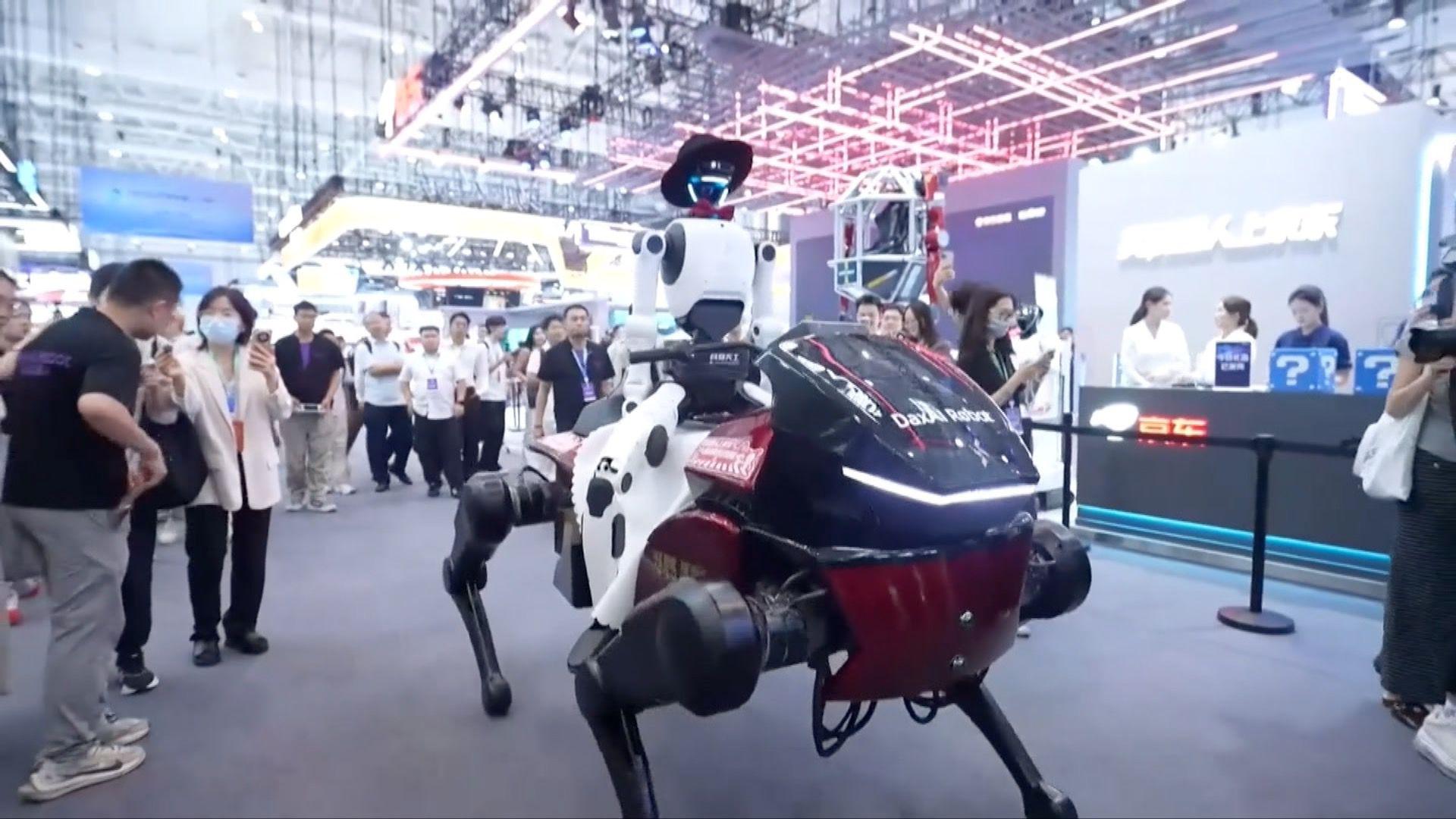
A futuristic rideable robot horse has become one of the biggest attractions at China’s 2026 World Robot Conference, offering visitors a glimpse of what transportation and robotics could look like in the years ahead.
A robot horse carrying a human rider has captured widespread attention at the 2026 World Robot Conference in Beijing, where hundreds of companies are showcasing advances in robotics and artificial intelligence.
The unusual machine, developed by Chinese robotics company DaxAI, combines the appearance and movement of a four-legged animal with technology more commonly associated with autonomous robots and motorcycles. Visitors at the event were able to climb onto the robot and ride it across the exhibition floor. (Geo News)
The demonstration has quickly become one of the conference’s most memorable attractions, highlighting how robotics is moving beyond traditional industrial machines and into systems designed to interact directly with people.
Meet the Qiji X1 Cyber Horse
The robot is officially known as the Qiji X1 All-Terrain Intelligent Mount, and it is designed to function as a rideable quadruped platform.
According to information presented around the machine, the Qiji X1 can carry a payload of up to 300 kilograms and is designed to operate across challenging terrain, including gravel, mud and steep slopes. Its reported top speed is around 10 kilometres per hour, with a range of approximately 40 kilometres. (Global Times)
Unlike conventional wheeled vehicles, a four-legged robotic platform can potentially maintain mobility across surfaces where wheels may struggle. That makes the technology particularly interesting for applications beyond recreational riding.
More Than a Science-Fiction Showpiece
While seeing a person riding a robotic horse may initially seem like a novelty, developers are looking at practical applications for this type of technology.
Potential uses include off-road transportation, logistics, heavy-load carrying and emergency response. A machine capable of navigating uneven terrain could potentially help transport equipment or supplies in locations where conventional vehicles are difficult to operate.
This is part of a wider trend in China’s robotics industry, where developers are increasingly working on machines capable of leaving controlled factory environments and operating in complex real-world conditions. (Global Times)
China’s Growing Robotics Ambitions
The robot horse appeared at a particularly significant moment for China’s robotics sector.
The 2026 World Robot Conference has brought together more than 300 companies, showcasing a broad range of robotic technologies. Humanoid robots, quadruped machines and other autonomous systems are among the technologies attracting attention at the five-day event. (Українські Національні Новини (УНН))
The event also comes as China’s robotics industry continues to expand rapidly, with manufacturers increasingly competing in areas ranging from industrial automation to consumer and service robots.
The result is a new generation of machines designed not merely to perform repetitive factory tasks, but to move through the physical world, carry objects and interact with humans.
It’s Not the Only Robotic Horse Making Headlines
The Qiji X1 is part of a larger wave of horse-inspired robotic technology emerging from Chinese companies.
At the World Artificial Intelligence Conference in Shanghai earlier this year, several robotic horses and rideable quadruped machines attracted crowds. One riding robot was reported to have a top speed of 15 kilometres per hour, a range of up to 20 kilometres and the ability to climb slopes of up to 25 degrees. (A News)
Hangzhou-based DEEP Robotics has also developed a smaller robotic horse based on its quadruped robotics technology. The machine was created as a limited-edition model for the 2026 Year of the Horse and is designed around technology used in areas such as inspection, emergency rescue and logistics. (Global Times)
Could Robotic Horses Become a New Form of Transport?
The bigger question is whether rideable robots will eventually move beyond exhibition halls.
For now, the technology remains relatively experimental. Mechanical movement, battery capacity, safety, cost and reliability are all challenges that developers will need to overcome before machines like the Qiji X1 become commonplace.
However, the underlying concept is significant.
A robot capable of carrying a person while independently navigating difficult terrain could occupy an interesting space between a motorcycle, an all-terrain vehicle and an autonomous robot.
Instead of requiring roads or tracks, future versions could potentially be designed to move across environments that are difficult for conventional vehicles to reach.
The Road Ahead for Quadruped Robotics
The rise of rideable quadruped robots illustrates a broader shift in robotics.
For years, robots were primarily associated with factories, laboratories and controlled environments. Today’s machines are increasingly being designed to operate alongside people and in unpredictable environments.
From robotic dogs used for inspection to humanoid robots and autonomous vehicles, developers are experimenting with machines that can perceive their surroundings, maintain balance and respond to changing conditions.
The robot horse may therefore be more than an eye-catching conference attraction. It represents another step toward a future in which robotic systems could become part of everyday transportation, logistics, recreation and emergency services.
A Glimpse Into Tomorrow
A person riding a mechanical horse through a technology exhibition may look like something from a science-fiction movie.
But at the 2026 World Robot Conference in Beijing, it became a demonstration of real engineering.
The technology still has a long way to go before robotic horses become a familiar sight on roads or trails. Yet the rapid development of quadruped robotics suggests that the boundary between science fiction and practical technology is becoming increasingly difficult to define.
The future of transportation may not have four wheels — it might have four legs.
Follow DLS Tech for more technology, artificial intelligence, robotics and innovation news.